Global commodity prices are up 26% in a year. Hormuz closure, Russia-Ukraine, a hardening turn to protectionism and the strongest El Niño in decades will push them higher still. Inflation forecasts have already increased, we expect them to be revised up again in October, and interest rates across the West to rise.
A year ago, the International Monetary Fund predicted global inflation would fall to 3.6% in 2026. They were cautiously optimistic, despite the US tariff announcements and short-lived Israel-US conflict with Iran. However, they warned "Geopolitical tensions could disrupt global supply chains and push commodity prices up." A year on, geopolitical tensions have erupted, supply chains have been severed and commodity prices have sky-rocketed. The IMF has upped its estimate on global inflation this year to 4.7%. A trend across Diplomatic Insight's first few Weekly Briefs has been global events squeezing prices. Here we bring that reporting together and consider the global outlook.
The Israel-US war may have temporarily set back Iran's nuclear programme, but it has been (predictably) disastrous for regional stability and the global economy. Even an optimistic forecast does not see the Strait of Hormuz returning to pre-war traffic until well into 2027. Our, more pessimistic, view is that while traffic may return, the heightened risk in the destabilised region will remain. Shipping, energy, and fertiliser prices have all been affected and will remain vulnerable. Gas has continued to climb past the conflict's peak in April. Supply chain costs are increasing globally as a result.
The choices being made in the Gulf are exacerbating existing pressures. The Ukraine-Russia conflict has intensified this summer, with both countries successfully striking deeper into each other's territories. Civilian casualties and damage to infrastructure in Ukraine are the highest they have been since 2022, and Ukrainian strikes on the Russian economy are increasing the cost of the war. Strikes on Russian oil refineries have reduced capacity by a third and are directly impacting fuel prices in Russia and throughout Central Asia. Together, Russia and Ukraine account for 28% of global wheat trade, and attacks this month on grain terminals have caused local emergencies and cut exports through the Black Sea.
Food prices are being hit by climate change as well as conflict-induced costs. Chicago wheat futures hit a three-year high this month. The US is heading for its lowest wheat yield since 2015, the EU has cut its forecast by nine million tonnes, and Canada's crop is down 13%. Australian and Argentinian wheat supplies will also be low when they hit the market later in the year and world stocks are forecast to fall by around 3%. Drought is also forcing the Panama Canal Authority to cut daily transit slots by around 10% this month, with more restrictions expected as El Niño reduces rainfall during the wet season.
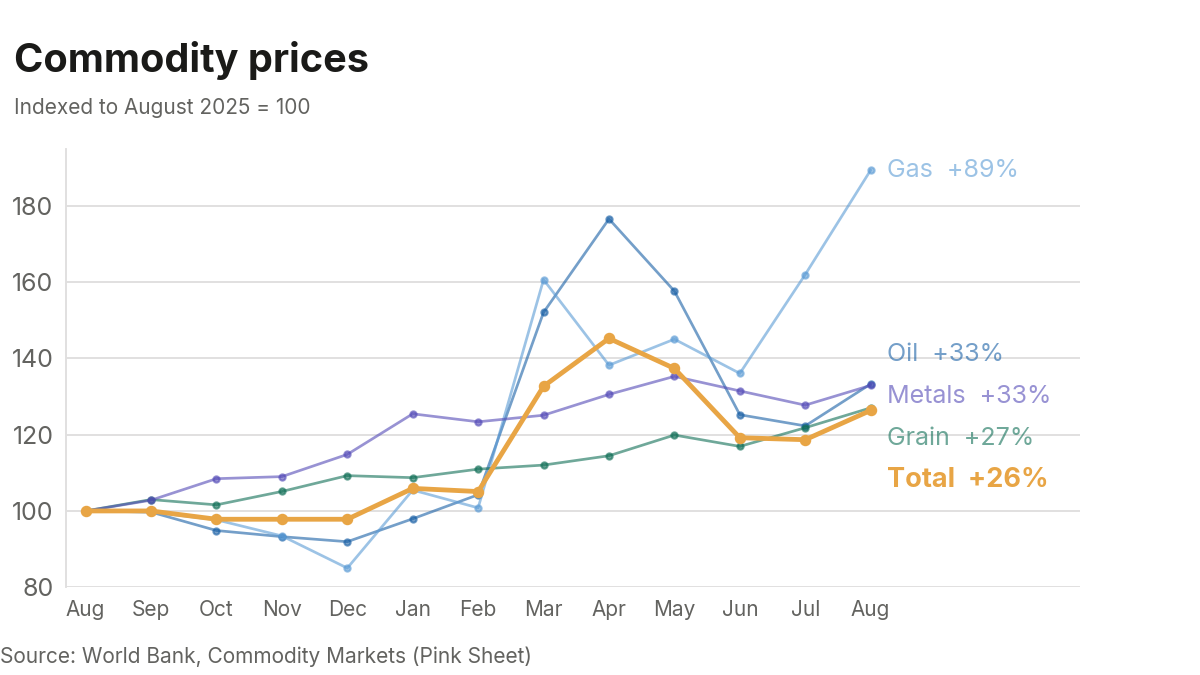
The World Bank's regular reporting of global commodity prices shows a rise of 26% over the past year. Against that backdrop, governments are becoming more protectionist and exacerbating the issues. Chief among them is the US, which in the last two weeks has restarted strikes across the Strait of Hormuz and imposed 50% tariffs on about $20bn of Canadian imports. The EU is imposing regulatory measures sure to increase the cost of business and prices, including a ban on Brazilian meat imports this month. India prohibited sugar exports in May, China has restricted its fertiliser exports and has imposed strategic export controls for the first time.
Countries are dealing with years of sustained price rises. Inflation in advanced economies averaged 1.5% in the decade to 2017, it has doubled in the decade since, reaching a 40 year high of 7.3% in 2022. Consumer prices in the EU, UK and US are around 25-30% higher now than on the eve of the pandemic, while real wages have lagged behind. Democratic governments are struggling with the consequences, no incumbent party gained vote share in 2024 and only a few reversed that trend in 2025 (notably Canada). Populist parties are gaining ground, with the Kiel Institute estimating a ten point inflation surprise increases the votes for radical parties by 15%. Ironically, Donald Trump was one of the electoral beneficiaries, promising to end the "inflation nightmare" in 2024.
In increasing its estimates in July for this year, the IMF forecast global inflation to ease to 3.9% in 2027. However, that assumed Hormuz would reopen from mid-July and return to pre-war levels by March 2027. Climate pressure on food and shipping prices will increase. The coming El Niño rise in sea temperatures is predicted to be the strongest since 1950, with resulting weather almost certain to damage harvests through 2027 and impact shipping. There may be some let up in gas prices after winter, assuming the new LNG export capacity expected in the US, Qatar, Canada and Russia is able to reach export markets. However, we expect inflation forecasts to be revised up in October and interest rates across the West to rise. Political pressure on the cost of living will continue, and expect further populist gains and protectionism during 2027.