Weekly Brief: 2 September 2026
Our view this week
This week's brief reflects the conflict, climate, regulatory and structural issues all pushing up global consumer prices. States already grappling with the political consequences of sustained high inflation are unlikely to see pressures ease any time soon. Some of these pressures could be reduced by responsible leadership. However, the restart of strikes across the Strait of Hormuz suggests that is unlikely.
Washington has successfully thrown its weight around to secure Venezuelan oil supplies, pushing out Russian and Chinese interests. Russia is throwing its own weight around threatening Europe, including a drone attack on Leipzig Airport. China, Russia and the other members of the Shanghai Cooperation Organisation reaffirmed their friendship this week at a summit in Kyrgyzstan. They signed a range of security and technical cooperation agreements. The tectonic plates are moving, as they say.
|
|||||
|
Brent crude, European gas (TTF), gold, USD/EUR, urea. Source: OilPriceAPI, 1 September 2026. |
Key issues
Trade & Supply Chains·Europe & Eurasia
Black Sea attacks and global drought push wheat to a three-year high
Chicago wheat futures hit a three-year high on 28 August. This follows a month of strikes against grain terminals in Russia and Ukraine, which between them account for 28% of global wheat trade. Ukraine's Infrastructure Ministry recorded 67 attacks on port facilities in July. Russia's Rostov region declared a state of emergency over crops stuck on farms. Drought has cut supply too. The US Department of Agriculture expects the lowest American wheat yield since 2015, and the European traders' association COCERAL has cut its EU crop forecast by around 9 million tonnes. World stocks are forecast to fall by around 3% this season. Our view is that food inflationary pressure will continue to rise, with global impact. Much of the rise is caused by the war in Ukraine and Hormuz's impact on fertiliser and energy prices. The pressure might ease once Black Sea loadings resume and if the US and Iran resolve the Hormuz crisis, but progress is not expected soon. Indications are that Australian and Argentinian wheat supplies will also be low when they hit the market in December. Together they usually represent about 17% of global trade.
Trade & Supply Chains·Americas
Washington takes a stake in Venezuela's oil reserves
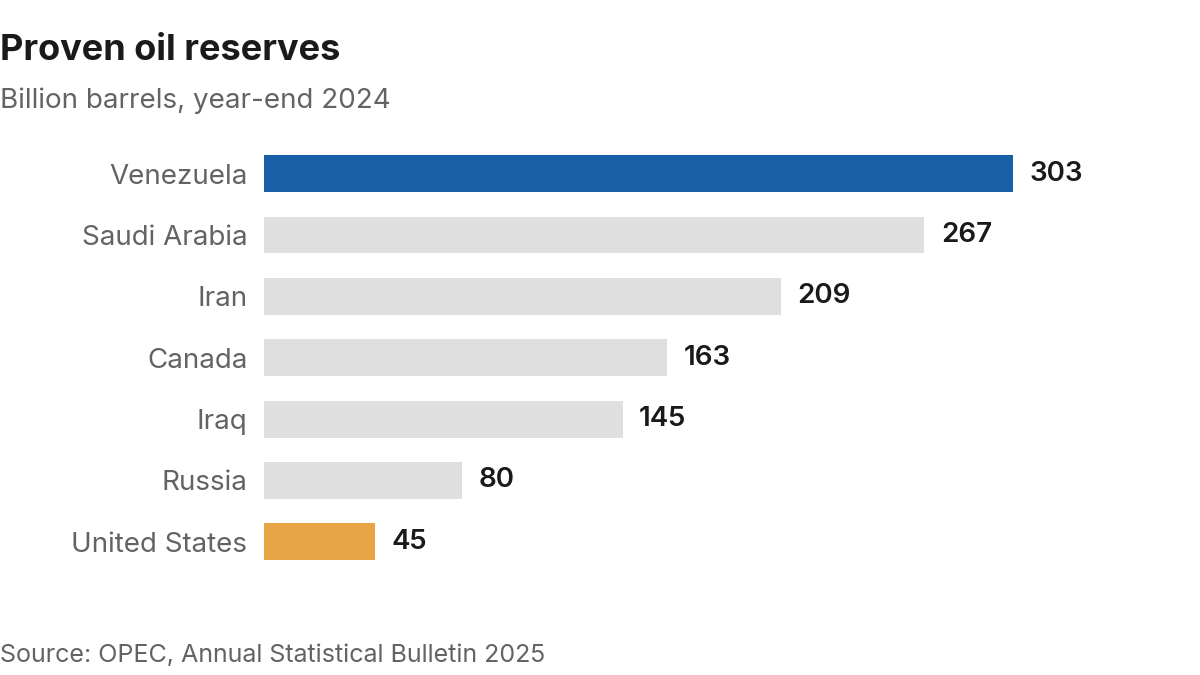
The White House said on 31 August that Venezuela's interim authorities had granted 100-year concessions over 17 oil fields to North American Blue Energy Partners. This represents about 65bn barrels of around 300bn proven reserves in Venezuela, more than the US's total domestic reserves (45bn). Most of these fields were previously run by Russian or Chinese firms. The Department of War's Office of Strategic Capital takes a 35% stake in the parent company, and Washington holds a veto over board appointments. The State Department may buy a fifth of output at production cost and has first refusal on the rest. Our view is that this cements the strategic shift in influence in Venezuela, following the US operation to arrest President Maduro in January. It also shows the US is comfortable working with the remnants of Maduro's regime and will not be pushing for political change. Little will change on oil supply before 2030, given the years of work needed. But Venezuela will be looking to maximise the promised $100bn investment programme, and increase US support in the wake of the catastrophic earthquake in June 2026.
Defence & Security·Europe & Eurasia
Germany blames Russia for the drone attack on Leipzig airport
Interior Minister Alexander Dobrindt said on 1 September that Russia was behind an attempted drone attack at Leipzig/Halle airport on 4 August. An explosives-carrying drone was found beside a Ukrainian cargo aircraft and defused. Leipzig airport was also hit by an incendiary device in 2024. Berlin will close Russia's consulate in Bonn, end the Russian House cultural agreement and tighten entry rules for Russian nationals. The International Centre for Counter-Terrorism reported in February 2026 that there had been 151 incidents tied to Russia across Europe in the last four years, with Poland the most affected at 31. Our view is that Russia is becoming increasingly brazen in its threats to Europe, but its efforts are only likely to increase European support for Ukraine and defence budgets. Russia has also raised its public threats to the UK and France in the last week, saying they are "playing with fire" by supporting Ukrainian long-range missile production. It is unlikely this will produce a noticeable change in approach, given the hybrid campaign already under way.
Also this week
Tankers hit in the Strait of Hormuz as the US and Iran trade strikes again. US forces struck two Iranian rocket launchers on Larak Island on 30 August, and Iran answered against two US-linked bases in Jordan. The following night two supertankers were hit as they attempted to leave the Gulf. Brent rose almost 8% over the week. Resource Security · Middle East & North Africa
US Fed Reserve Chair warns on inflation in his first Jackson Hole speech. Kevin Warsh used his first Jackson Hole address as Federal Reserve Chairman on 28 August to say inflation is too high and that the Fed has work to do. The symposium came as inflation and the cost of government debt rise across the West. Politics & Governance · Americas
|
|||
|
Source: US PCE price index, 12-month change (BEA via FRED), Jul 2026; US Treasury, Debt to the Penny, 18 Aug 2026; 10-year Treasury yield (FRED DGS10 / Federal Reserve H.15), 31 Aug 2026
|
Xi, Putin and Modi meet at the SCO summit in Bishkek. The Shanghai Cooperation Organisation marked its 25th anniversary on 31 August with more than a dozen heads of state present. Agreements were signed on a variety of issues, including a new counter-threat centre. The long-proposed development bank still has no capital or launch date. The Kremlin said the Xi-Putin talks were mostly economic and touched Ukraine only in passing. Politics & Governance · Global
EU bans Brazilian meat over antibiotic rules. The EU's removal of Brazil from its approved supplier list takes effect on 3 September. EU inspectors began a two-week audit on 24 August and Brazil has not given the guarantees the bloc requires on antibiotic use. The EU took 231,000 tonnes of Brazilian chicken last year, and beef sales to the bloc rose almost 16% in the first half of 2026. Trade & Supply Chains · Americas
India rejects the Hague ruling on the Indus Waters Treaty. The Permanent Court of Arbitration ruled on 31 August that the 1960 India-Pakistan treaty remains binding. It ordered India to limit work on the Ratle dam in Kashmir. India's foreign ministry rejected the court's jurisdiction outright. Resource Security · South Asia
Nepal's flood death toll passes 1,000. Nepal's disaster authority recorded more than 1,000 deaths by 31 August, five days after a glacier collapse near the Tibetan border. Around 930 workers are missing at 11 hydropower sites. The finance minister put losses above $4bn. There is an international recovery effort underway. Conflict & Instability · South Asia
Turkish and Somali forces retake a hijacked cargo ship. Somalia's government said on 29 August that Turkish and Somali forces had freed the MV Lutuf, held since 17 August, killing 14 pirates. Puntland's authorities dispute that and say a ransom was paid. Hijacking off Somalia has returned after a decade in which it had all but stopped. Conflict & Instability · Sub-Saharan Africa
Libya's rival administrations sign a two-year election plan. Representatives of the Tripoli and eastern authorities signed a deal at the UN mission on 30 August to hold elections within 24 months. The unresolved question is who governs and controls oil revenue in the meantime. Politics & Governance · Middle East & North Africa
Shein lists in Hong Kong at a quarter of its 2022 valuation. The Chinese fashion group raised about $1.7bn on 1 September at a valuation near $26bn, against $100bn in private markets four years ago. Shares fell as much as 10% before closing near the offer price. Tariffs, regulators and Temu explain part of that gap. Trade & Supply Chains · Asia-Pacific
Coming up
| 6 Sep | German state election in Saxony-Anhalt |
| 13 Sep | Sweden's general election |
| 24 Sep | Xi Jinping's state visit to Washington |
Diplomatic Insight is a British geopolitical analysis and consultancy practice with real diplomatic experience. For further analysis on any of the issues covered here or for any bespoke reporting, contact info@diplomaticinsight.co.uk.
Subscribe to get the next issue by email.