30 September 2026
Our view this week
Xi Jinping has been in Washington this week, his first state visit in over a decade. In the end, it was relatively underwhelming, which suited both sides. The trade truce has been extended, a coal deal struck and a new AI dialogue agreed. The AI (or 'Super Intelligence'...) dialogue and incident channel will be something to watch. It will not stem the strategic competition, but may help in working towards safeguard standards.
Otherwise, it's been a relatively calm week in geopolitics, with leaders presumably recovering from the New York hangover. Or more likely realising their domestic issues are pretty difficult. Russia's new budget increases defence spending at the expense of welfare. Similar debates are happening across Europe. The US has been quietly helping Saudi Arabia smuggle oil through Hormuz, but is still facing high fuel prices and a hotly contested mid-term election.
|
|||||
|
Brent crude, European gas (TTF), gold, USD/EUR, urea. Source: OilPriceAPI, 29 September 2026. |
Key issues
Trade & Supply Chains·Asia-Pacific
Xi's state visit to Washington extends the US-China trade truce
Xi Jinping made his first state visit to the US in over a decade from 23 to 25 September. The two sides extended their trade truce from 10 November to 10 January. On 28 September they published lists of goods, worth about $30bn in each direction, that will move to low standard tariffs. Semiconductors, electric vehicles, batteries and US soybeans remain on current tariffs. China committed to buy at least 10 million tonnes of US coal a year in 2027 and 2028, and to tighten controls on fentanyl chemicals. The leaders also set up an AI dialogue and incident channel. There was no change on Taiwan or Iran. Our view is that the visit successfully kept relations calm but changed little of substance. The average US tariff on Chinese goods falls only from about 22% to about 20.5%, roughly double its level before Trump returned to office. Washington extended the truce without any public Chinese commitment on rare earth exports, so Beijing keeps that lever. The leaders are expected to meet again at the Asia-Pacific Economic Cooperation summit in Shenzhen in November.
Defence & Security·Europe & Eurasia
Russia's 2027 budget raises war spending and cuts welfare
Russia's draft budget for 2027 sets defence spending at 17.1 trillion roubles (about $200bn), 27% more than previously planned and the highest figure since the invasion of Ukraine. It represents 7-8% of GDP. Spending on welfare, health and education falls by 6% to 7% against earlier plans. Borrowing rises and the 2026 deficit forecast has doubled to 3.2% of GDP. Our view is that Moscow is budgeting for the war continuing and the need to invest in broader defence assets. The draft goes to the new Duma by 1 October, and we expect it to pass largely unchanged within weeks. The Kremlin is choosing to absorb the strain on the economy, which is looking increasingly shaky. For Ukraine and European governments, that makes it unlikely economic pressure alone will force Russia into a ceasefire next year. Parts of Russian defence spending are classified, so the real figure is likely higher.
Resource Security·Middle East & North Africa
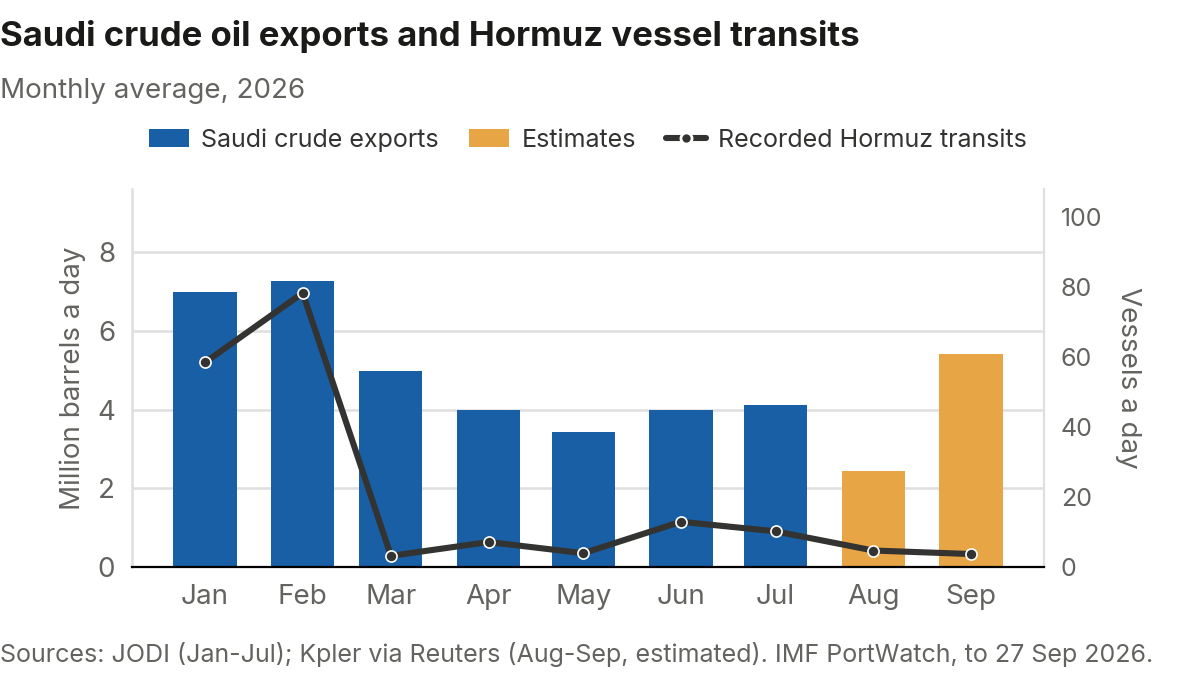
Saudi oil exports climb despite the Hormuz closure and Houthi attacks
Saudi crude export estimates rose sharply in September, to their highest level since the Iran war began, according to the ship-tracking firm Kpler. This came despite the continued threat to vessels in the Strait of Hormuz, a drone attack that shut the pipeline to the Red Sea port of Yanbu last week, and Houthi missiles fired at Yanbu on 24 and 25 September. Washington rejected Iran's offer to reopen the strait on 26 September. While recorded Hormuz transits remain low, loadings at Ras Tanura in the Gulf roughly quadrupled from August, and some tankers have been making the journey with their transponders switched off. Crude is also handed to buyers' ships off Fujairah and Sohar, outside the strait. And the pipeline to Yanbu is running again. Our view is that the US has worked hard to create some routes through Hormuz, and September's figures are a welcome surprise, which may help ease pressure on crude prices slightly. But the recovery is still well below normal levels, is very fragile, and is not sustainable with every route still exposed to Houthi, Iranian or militia attack. Fuel prices are still climbing. With US diesel near $6.50 a gallon, Donald Trump said on 27 September he was considering a diesel export ban. Importers such as Britain and Brazil are lobbying hard against that.
Also this week
Russia's shadow fleet comes out of the shadows. The Centre for Research on Energy and Clean Air reported on 25 September that European boardings and seizures have more than halved the number of Russian oil tankers sailing under false flags. Many have switched to the Russian registry instead, to protect them from Europeans unwilling to spark a direct confrontation with Moscow. Sanctions & Export Controls · Europe & Eurasia
US sanctions Russia-China-Iran arms links. The US Treasury and State Department sanctioned 13 people and entities in Russia, China, Hong Kong and Pakistan on 29 September for helping Iran buy weapons. Sanctions & Export Controls · Global
Five men arrested near US airbase in the UK. Counter-terrorism police arrested five men near RAF Fairford, the base in England used by US bombers in the Iran war, on 27 September. They have been bailed and no explosives were found, but police are investigating possible links to a foreign state, likely Iran. Defence & Security · Europe & Eurasia
Tigrayan forces push into Ethiopia's Afar region. Fighting between federal troops and Tigrayan forces resumed on 22 September, and Tigrayan fighters took the town of Erebti in Afar on 28 September. Ethiopia's army chief accused Sudan, Egypt and Eritrea of backing them. Conflict & Instability · Sub-Saharan Africa
Serbia's President Vučić to resign and run for prime minister. President Aleksandar Vučić announced on 27 September that he will step down to lead his party into snap parliamentary elections on 25 October. He was approaching his presidential term limit, so this is an effort to remain in power after almost a year of anti-corruption protests. Politics & Governance · Europe & Eurasia
Venezuela frees 39 political prisoners. Delcy Rodríguez's interim government released 39 political prisoners on 26 and 27 September, after US-approved talks with the opposition. She promised elections at the UN but gave no date. Without one, sanctions relief and foreign investment are unlikely to widen. Politics & Governance · Americas
Car bomb kills 13 at a Pakistani checkpoint. A car bomb at a security checkpoint in Dera Ismail Khan killed 13 people on 26 September, a week after an attack in Kohat killed more than 30. Pakistan blames the Pakistani Taliban and their bases in Afghanistan. Further Pakistani strikes across the border are likely. Conflict & Instability · South Asia
Taiwan plans to quadruple its ammunition stocks. Taiwan's defence ministry announced on 26 September a six-year, $850m plan to raise critical ammunition reserves from 30 days of supply to 120 days. The plan is designed around holding out through a Chinese blockade. It still needs approval from the legislature. Defence & Security · Asia-Pacific
Coming up
| 3 Oct | Latvia parliamentary elections |
| 4 Oct | Brazil general election, first round |
| 4 Oct | Bosnia and Herzegovina general election |
| 12-18 Oct | IMF and World Bank annual meetings, Bangkok |
Diplomatic Insight is a British geopolitical analysis and consultancy practice with real diplomatic experience. For further analysis on any of the issues covered here or for any bespoke reporting, contact info@diplomaticinsight.co.uk.
Subscribe to get the next issue by email.