14 October 2026
Our view this week
While it may appear that the madness of King Donald has reached new levels this week, that is only partially true. Trump surprised Kyiv and other allies with a deal to buy Russian diesel. He then falsely claimed to have negotiated an energy ceasefire. Madness? Maybe. But he has successfully tied the media stories on diesel and energy prices to the Ukraine conflict in a way that the facts could never have done.
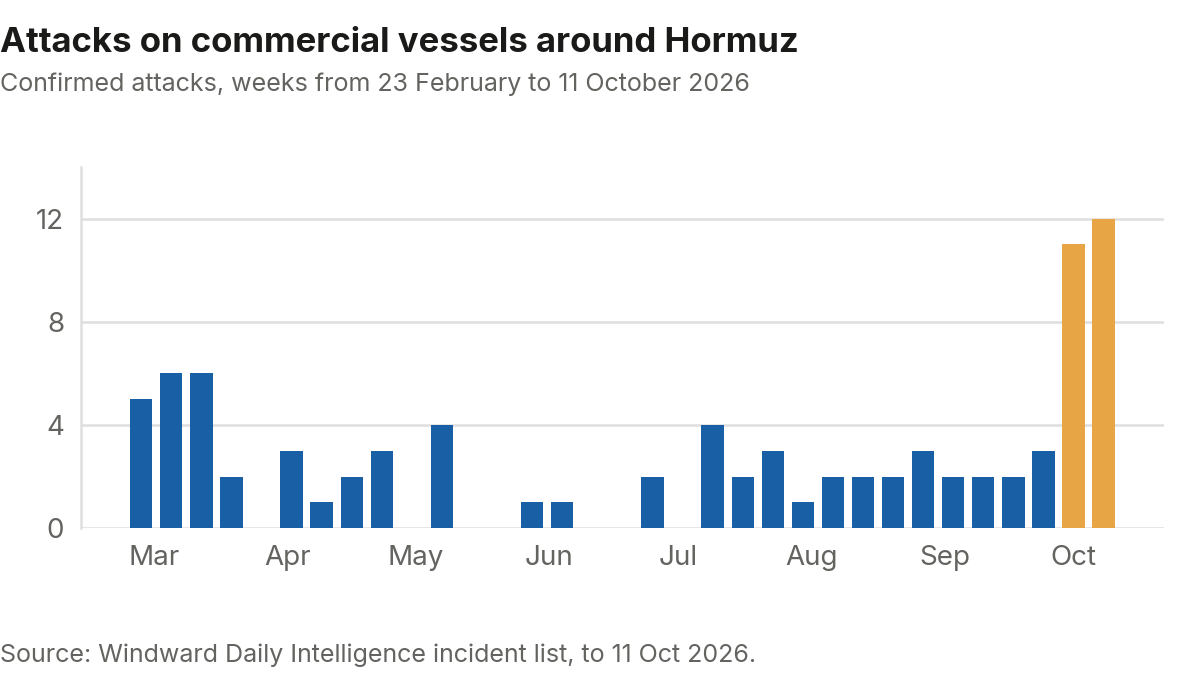
After some US success at smuggling fuel through Hormuz in September, Iran has successfully fought back. Attacks on Hormuz shipping reached their highest level of the conflict, Houthi missiles shut Riyadh's main airport, and the US can't bring itself to negotiate seriously before the midterms. So, we wait. We'll cover the US, Israeli and Brazilian elections in more detail in the next two weeks.
|
|||||
|
Brent crude, European gas (TTF), gold, USD/EUR, urea. Source: OilPriceAPI, 13 October 2026. |
Key issues
Sanctions & Export Controls·Europe & Eurasia
Trump eases Russian diesel sanctions and turns on Kyiv
Donald Trump announced a deal with Vladimir Putin on 9 October allowing Russian diesel to be sold to the US and other markets despite sanctions. Russia partly lifted its own export ban the next day. The initial volumes represent roughly one day of US diesel use. Trump then said Ukraine should replace President Zelensky, who reacted angrily to the deal. Trump then went on to declare an energy ceasefire that neither Kyiv nor Moscow had agreed to, and threatened to cut intelligence sharing over Ukrainian strikes on Russian refineries. Ukraine's Air Force said it got no allied warning of Russian missile launches on 12 and 13 October. Our view is that the diesel volumes are small, but even then are unlikely to be delivered, especially given Ukraine's success at striking refineries. Trump is attempting to distract domestic voters from the real cause of record diesel prices, his conflict with Iran.
Trade & Supply Chains·Middle East & North Africa
Attacks on Hormuz shipping reach a wartime high as talks stall
Iranian missile and drone attacks on ships around the Strait of Hormuz have been at their most intense of the war in the last two weeks. Six vessels were attacked on 11 October alone. The same day, Iran's security chief Mohsen Rezaei called the US reply to Iran's plan to reopen the strait insufficient. Trump said on 8 October the US would not attack Iran before the midterms, then said the next day "we may", and has been deploying more military assets to the region. Brent crude has stayed above $100 a barrel. Our view remains that it will be well into 2027 before the strait reopens. The IMF shares that view, and is assuming it doesn't reopen before March 2027. The increased strikes eliminate the successful transits the US had managed in September, and maintain the pressure on prices and Trump ahead of the US midterms.
Conflict & Instability·Middle East & North Africa
Houthi missiles kill 13 and close Riyadh airport
A Houthi missile on 10 October killed 13 people and wounded over 300 at Riyadh's King Khalid International Airport, according to Saudi authorities. It was the deadliest attack on Saudi soil in over a decade. The airport is closed until at least 17 October, and nearly half of flights across Saudi airports were cancelled on 12 October. The UK Foreign Office now advises against all but essential travel to Riyadh. Trump said the US was considering joining Saudi strikes against the Houthis. Our view is that the Saudi conflict with the Houthis has reached a dramatic new stage, and the Houthis are now treating Saudi civil infrastructure as a routine target. Repeated hits show Saudi air defences cannot reliably stop them. Risk levels for firms with staff in Riyadh and working on oil sites are now extremely high. We expect strikes to continue for as long as the Saudi-backed offensive on Yemen's Red Sea coast goes on. The UK has already offered limited military support and US involvement is looking more likely.
Also this week
Ethiopia's army reaches the Eritrean border. Ethiopian troops entered the border town of Zalambessa by 13 October. Ethiopia has told the UN Security Council that Eritrean forces advanced up to 60 km into its territory. Eritrea denies this and has asked the Council to act against Ethiopia, so direct clashes between the two armies are now a real prospect. Conflict & Instability · Sub-Saharan Africa
UK and EU widen Russia sanctions as Washington eases. The UK sanctioned two more Russian oil producers and 12 shadow fleet tankers on 8 October, bringing its total to over 600 tankers. The EU added over 800 arms-industry companies and over 700 executives on 12 October, its largest-ever listing. Sanctions & Export Controls · Europe & Eurasia
EU and China agree a cap on Chinese hybrid car exports. Imports of Chinese hybrids and plug-in hybrids would be capped at 350,000 a year from 1 December under a deal the European Commission negotiated with Beijing, against about 800,000 expected this year. EU leaders will consider it on 15-16 October. Trade & Supply Chains · Europe & Eurasia
UK blames Iran's Revolutionary Guard for plot against US bomber base. Prime Minister Andy Burnham told Parliament on 12 October that Iran was almost certainly behind a suspected plot to attack RAF Fairford, where US bombers were based. The MI5 Director has also reported high levels of state threats. Defence & Security · Europe & Eurasia
US sanctions the International Criminal Court. Secretary of State Marco Rubio announced a ban on transactions with the court on 9 October, with a six-month grace period for member states to address US concerns. The EU has said it will help the court keep working. Sanctions & Export Controls · Global
China sanctions Paraguayan and Belizean ministers over Taiwan. Beijing froze the assets in China of Paraguay's communications minister and Belize's foreign minister on 12 October and barred Chinese firms from dealing with them. It is a low-cost warning to Taiwan's 12 remaining diplomatic allies, and we expect more targeted measures of this kind. Sanctions & Export Controls · Asia-Pacific
Joseph Kabila takes charge of eastern Congo's rebels. Congo's former president will lead a new front replacing the M23 rebel alliance, with rebel leaders as his deputies, the group announced on 12 October. A national political figure at its head could make a settlement harder, and Kabila has attacked Congo's minerals deal with the US. Conflict & Instability · Sub-Saharan Africa
Pakistan suspends the government of Khyber Pakhtunkhwa. President Asif Ali Zardari declared a state of emergency on 11 October after protests for jailed former prime minister Imran Khan's release. It hands Islamabad control of the province run by Khan's party. Direct rule is likely to bring more protests and raise security risks in the northwest. Politics & Governance · South Asia
Coming up
| 15-16 Oct | European Council, Brussels |
| 18 Oct | The US Sanctioning Russia and Iran Act takes effect |
| 25 Oct | Brazil presidential runoff |
| 27 Oct | Israel general election |
| 3 Nov | US midterm elections |
Diplomatic Insight is a British geopolitical analysis and consultancy practice with real diplomatic experience. For further analysis on any of the issues covered here or for any bespoke reporting, contact info@diplomaticinsight.co.uk.
Subscribe to get the next issue by email.