28 October 2026
Our view this week
We failed to mention Serbia in last week's Election Watch, with Aleksandar Vučić maintaining his autocratic grip on power seen as inevitable. But there were celebrations on the streets of Belgrade this week after a largely leaderless student protest movement removed his party after 14 years in power. He has followed fellow populist autocrat Viktor Orbán out of the door, in a victory for central European progressives. But don't expect major foreign policy changes anytime soon, as Serbia's new government will focus on taking control of corruption.
Brazil saw another suprise result, with Lula holding on to the presidency. His right-wing opponents will make life difficult for him in Congress and with US support. The other big election this week took place in Israel yesterday. It's too early to know the full results but it is looking tight and, as expected, inconclusive. Neither Netanyahu nor his main challenger Eisenkot have the numbers to form a majority. Coalition talks are likely to run on for months, with Netanyahu as caretaker. Another election is a possiblitity. As we said last week, don't expect major changes to the approach to Gaza, the West Bank or the wider region.
|
|||||
|
Brent crude, European gas (TTF), gold, USD/EUR, urea. Source: OilPriceAPI, 27 October 2026. |
Elections watch
Politics & Governance·Europe & Eurasia
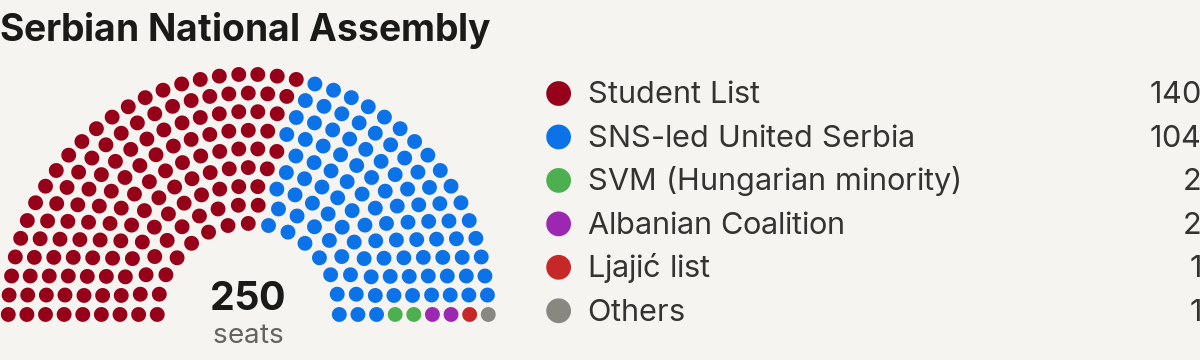
Student-led movement ousts Vučić in Serbia
Serbia's Student List, which grew out of nearly two years of anti-corruption protests, won almost 53% of the vote in the 25 October snap parliamentary election. Aleksandar Vučić's Serbian Progressive Party (SNS) took just over 39%, according to preliminary results. Vučić, who resigned the presidency in September to run for prime minister, conceded on election night. Our view is that this is a seismic result to deseat Vučić and his allies, who have had an autocratic grip on power for years. Their established networks of power through organised crime, football hooliganism and state security bodies will be hard to shift. The Student List has become more organised, but is still fundamentally a protest movement, it will take them some time to nominate leaders and work out how to govern. They will focus on anti-corruption and governance issues on which it is easy to agree. Those hoping for a big shift away from Russia towards the EU, or progress on recognition of Kosovo, will have to wait.
Politics & Governance·Americas
Lula wins a fourth term in Brazil
|
51.8%
Lula da Silva
|
48.2%
Flávio Bolsonaro
|
President Luiz Inácio Lula da Silva won Brazil's 25 October runoff with almost 52% of the vote, overturning a first-round deficit against Flávio Bolsonaro. Bolsonaro, a senator and son of the jailed former president Jair Bolsonaro, says he will seek annulment. He cites a Supreme Court order that extended voting by two hours after some polling stations had closed, which both parties had asked for. The head of the electoral court has confirmed the result, and Bolsonaro's own Liberal Party has accepted it. Bolsonaro then left the country and may be traveling to the US, despite a Supreme Court travel ban linked to a corruption investigation. Our view is that we were right to say it was too close to call last week, with Lula's victory coming as quite a surprise. We can expect there to be continuing polarisation, especially if criminal cases against the Bolsonaro family are pursued and the Trump administration takes a hard stance against Lula. The right dominates Congress, and Bolsonaro has promised to make it a fortress against the government. Lula will have a hard time passing spending and tax measures through 2027.
Politics & Governance·Middle East & North Africa
Israel's election leaves both Netanyahu and Eisenkot short of a majority
Israelis voted on 27 October, with the highest turnout since 1999. Netanyahu's Likud is the largest party in the count so far, ahead of Gadi Eisenkot's Yashar!, but Netanyahu's bloc is still several seats short of the 61 needed for a majority. Eisenkot's bloc is further behind, and the Arab parties are heading for their strongest result in years. Soldiers' and other special ballots are still being counted, and official results are due on 4 November. Our view is that, on these numbers, no one can form a government. Netanyahu would need defectors from the opposition. Eisenkot can only reach 61 with Arab party support, which Naftali Bennett, a key ally, has ruled out. We expect Netanyahu to remain caretaker for months, which leaves him in charge if the US and Israel resume strikes on Iran. A repeat election in 2027 is now a possible outcome.
Bulgaria heads to a presidential runoff. Acting President Iliana Iotova, backed by Prime Minister Rumen Radev's party, took about 35% on 25 October against almost 32% for pro-Western Andrey Gyurov, on record-low turnout. The 1 November runoff is close, and an Iotova win would put an opponent of military aid to Ukraine in the presidency. Politics & Governance · Europe & Eurasia
Also this week
US and Israel plan renewed strikes on Iran. US officials say the two militaries have planned a roughly three-day operation against Iran's nuclear, energy and missile sites after the midterms, though Trump has not approved it. Iran has threatened energy targets and undersea cables in response. Conflict & Instability · Middle East & North Africa
Egypt authorises military support for Saudi Arabia. Egypt's parliament on 26 October allowed President Sisi to help defend Saudi Arabia against Houthi attacks if Riyadh asks. Cairo has ruled out attacking Yemen, so the likely help is air defence, border security and helping to control the Bab al-Mandab Strait. Defence & Security · Middle East & North Africa
Russia and Ukraine agree a local truce at Oleshky. A US-brokered ceasefire in the occupied town began on 27 October to let aid in and civilians out, and has since been widened within Kherson region. The Kremlin says three-way talks can resume after 4 November, but calls the first meeting a trial run. Conflict & Instability · Europe & Eurasia
Washington eases pressure on Russian energy. The first tanker of Russian diesel under the Trump-Putin deal left port on 22 October, and the White House is reported to be weighing lifting sanctions on Russia's state investment fund. Sanctions & Export Controls · Americas
Romania blames Russia for sinking a cargo ship. A drone strike sank the Comoros-flagged Khoryv about 13 nautical miles off Constanța on 23 October, leaving one crew member dead and three missing. NATO is sending more aircraft, drones and radar to the Black Sea. Defence & Security · Europe & Eurasia
Indonesia cuts pipeline gas to Singapore. Jakarta cut gas exports to Singapore by 9% from 23 October, citing domestic shortages, and its energy minister said Indonesia would not be lectured on contracts. Singapore can cover the gap with LNG, but this might be a growing trend. Resource Security · Asia-Pacific
Former Congolese president Kabila to lead a new front with M23. Joseph Kabila will head a new political-military front with M23 leaders as deputies, and DRC President Tshisekedi called him a Rwandan proxy on 27 October. Conflict & Instability · Sub-Saharan Africa
Coming up
| 29 Oct | European Central Bank rate decision |
| 31 Oct | UN Security Council vote may change Western Sahara mandate |
| 3 Nov | US midterm elections |
Diplomatic Insight is a British geopolitical analysis and consultancy practice with real diplomatic experience. For further analysis on any of the issues covered here or for any bespoke reporting, contact info@diplomaticinsight.co.uk.
Subscribe to get the next issue by email.