11 November 2026
Our view this week
Trump says the war with Iran is effectively over, and oil prices have fallen below $100 a barrel for the first time in months. But Tehran says there are no talks and the US is still weighing up military options. Iran still controls who passes through Hormuz, and a tanker hit a mine there today. Iranian threats in Europe have also increased, from commercial cyber attacks to attempted terrorist attacks, and the Houthis are still attacking Saudi Arabia. But slow and fragile change may be afoot in Israel.
A bright spot this week is the Russia-Ukraine talks in Abu Dhabi, the first serious talks since February and a welcome break from Trump's chaotic approach before the midterms. It's too early for substantive progress but expect confidence-building measures such as prisoner transfers. Prospects build for more successful diplomacy in 2027.
|
|||||
|
Brent crude, European gas (TTF), gold, USD/EUR, urea. Source: OilPriceAPI, 10 November 2026. |
Key issues
Conflict & Instability·Middle East & North Africa
US weighs up its next moves on Iran
US forces struck Iranian air defences on Qeshm island on 6 November. The next day, US Central Command set up a task force to extend its naval blockade of Iran to land borders and the Caspian Sea. On 9 November, after meeting Qatar's prime minister, President Trump said the war was "effectively over" militarily. Iran's top security official, Mohsen Rezaei, said there were no talks and Hormuz would stay restricted until the US met seven conditions from the June interim deal. On 11 November, Iran's army said a tanker had hit a mine in the strait, but Brent crude prices are down about 12% this week. Our view is that Trump's next move is still unclear. He is under considerable pressure to end the war, from domestic and international allies. Some have predicted the US could launch a new round of strikes, and it is prepared to keep the blockade running for months, if needed. We do not expect Hormuz to re-open soon.
Conflict & Instability·Europe & Eurasia
Russia and Ukraine resume US-brokered talks in Abu Dhabi
US, Ukrainian and Russian delegations met in Abu Dhabi on 10 and 11 November, the first three-way talks since February. President Zelensky said the first day covered a prisoner exchange of up to 1,500 on each side, steps to reduce fighting and security guarantees. Russia raised territory, which Zelensky said only leaders could settle. Moscow also returned to its December 2021 demands on European security, including an end to NATO expansion. Trump said beforehand that Ukraine would likely "end up with a little bit different shape". Our view is that these are a genuine attempt to restart serious talks, unlike US moves before the midterms. They will likely produce humanitarian and technical confidence-building steps, such as a large prisoner exchange. A truce covering energy and the Black Sea is possible before the coldest months, but still at the high end of expectations. Assuming no breakdown or rash moves by the US mediators, it could create some positive diplomatic momentum for substantial talks in the new year.
Politics & Governance·Middle East & North Africa
Eisenkot gets the first chance to replace Netanyahu
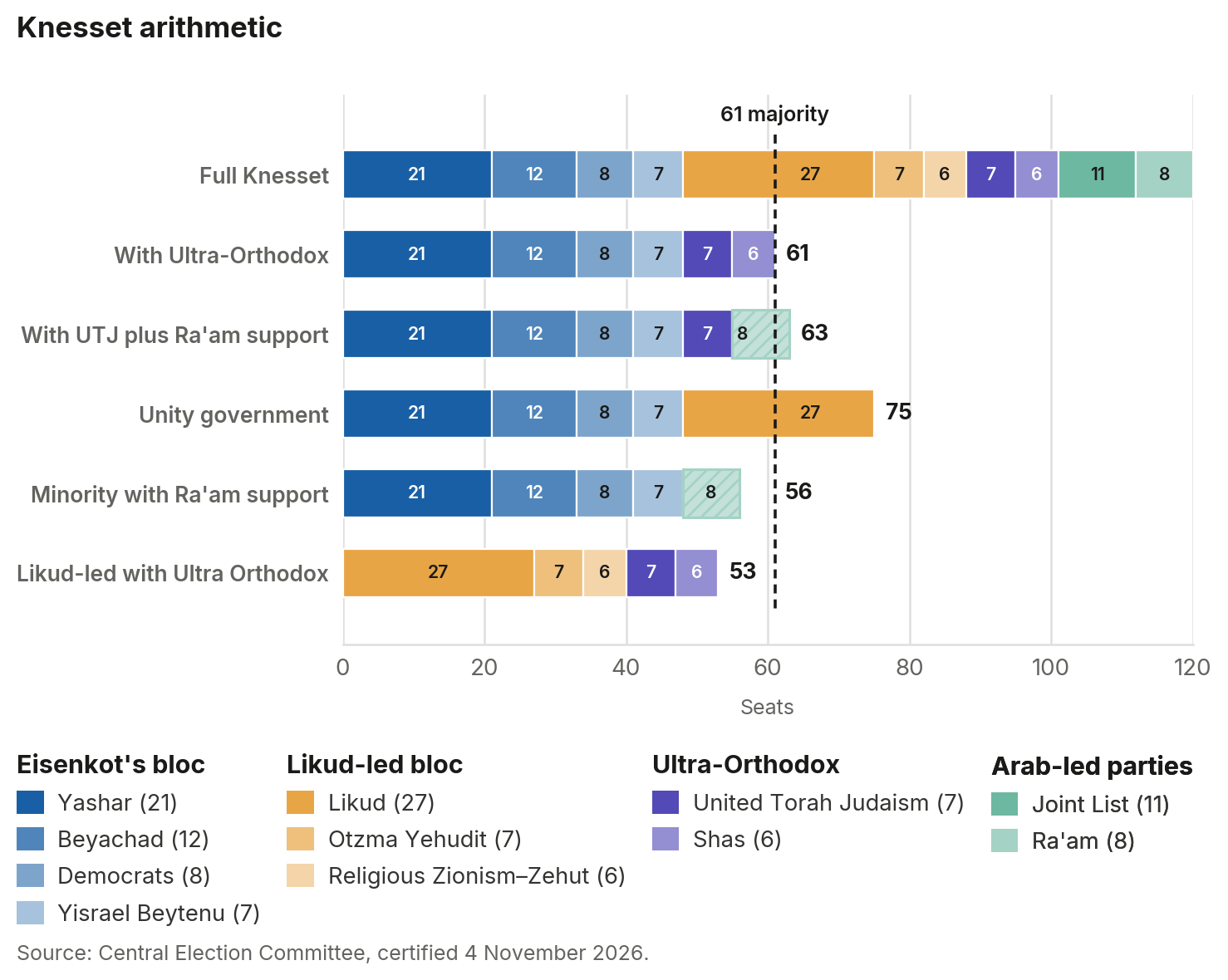
Israeli President Isaac Herzog gave Gadi Eisenkot, a former army chief, the first chance to form Israel's next government on 8 November. He has up to 42 days. His four-party bloc won 48 seats in the 27 October election, against 53 for Benjamin Netanyahu's bloc. Arab-led parties backed his nomination, but he has ruled out bringing them into government. Our view is that there are no easy coalition options. Promises made before the election can be bent, so Eisenkot will be exploring if anything is workable with ultra-Orthodox and Arab parties. Either would require concessions and may not be popular; both would be extremely fragile. We do not expect a quick deal, and still would not rule out new elections in 2027.
Also this week
Houthi attack damages Aramco tower in Riyadh. Saudi Arabia's energy ministry said debris from an attempted attack on 8 November damaged an Aramco office building in Riyadh's financial district, with no casualties. Houthi attacks on Saudi cities continue. Conflict & Instability · Middle East & North Africa
Russia rations petrol as refinery strikes bite. Rosneft has capped petrol sales per visit at its stations in several Russian regions, after Ukrainian drones disrupted 9 of Russia's 35 major refineries in a week. Fuel shortages strengthen Kyiv's hand in Abu Dhabi and make a Russian acceptance of an energy truce more likely. Resource Security · Europe & Eurasia
China extends its trade truce with the US to January. China kept its extra 24% tariff on US goods suspended for two more months from 10 November, and paused port fees on US-linked ships and some critical-mineral export controls until 10 January. Another short rollover keeps sourcing and pricing decisions on a two-month horizon, unless Trump and Xi agree a proposed package of reciprocal tariff cuts at APEC next week. Trade & Supply Chains · Asia-Pacific
Turkey stops Turkmen gas imports through Iran. Energy Minister Alparslan Bayraktar said on 6 November that gas from Turkmenistan via Iran had stopped because of US pressure, and Turkey's own gas contracts with Iran expire this month. Ankara's decision on renewal will show how far US sanctions now reach into Iran's neighbours. Sanctions & Export Controls · Europe & Eurasia
France blames Iran for supermarket fridge hacks. French officials said on 9 November that a cyber unit linked to Iran's Revolutionary Guards targeted refrigeration controls at over 700 commercial sites across France in October, causing at least 15 fires. France summoned Iran's ambassador. A second wave this month hit more than 100 sites in several European countries. Defence & Security · Europe & Eurasia
Paraguay removes President Peña over a bank collapse. The Senate voted 44 to 1 to remove Santiago Peña after the collapse of Ueno Bank left almost three million depositors without access and threatened state pension accounts. Vice-President Pedro Alliana now serves until 2028, and the pace of depositor payouts will decide whether the street protests end. Politics & Governance · Americas
South Africa's ANC records its worst result. Final results on 8 November gave the ANC about 31% in local elections, ahead of the Democratic Alliance on about 25%, leaving around 120 councils with no majority. Parties have 14 days to form administrations, and rushed coalitions point to more unstable management of water and power in many towns. Politics & Governance · Sub-Saharan Africa
Somalia's top court rules the president's extra year unlawful. The Supreme Court ruled on 5 November that President Hassan Sheikh Mohamud's term ended in May, a day after he dismissed the chief justice. A disputed presidency, as Ugandan troops prepare to leave and donors cut funding, presents risks of an al-Shabaab resurgence in 2027. Politics & Governance · Sub-Saharan Africa
Coming up
| 12 Nov | European Political Community summit in Dublin |
| 18 Nov | APEC leaders' summit in Shenzhen, with a Trump-Xi meeting expected |
| 19 Nov | Coalition of the willing meeting on Ukraine in Germany |
| 20 Nov | COP31 climate conference due to close in Antalya, Türkiye |
| 20 Nov | UK-EU summit in Brussels |
Diplomatic Insight is a British geopolitical analysis and consultancy practice with real diplomatic experience. For further analysis on any of the issues covered here or for any bespoke reporting, contact info@diplomaticinsight.co.uk.
Subscribe to get the next issue by email.