New US forced labour tariffs, announced to replace Trump's "Liberation Day" measures, have created a wave of new forced labour import bans. Implementation is not likely soon, especially given the escalation risks from China.
The US imposed tariffs on 60 of its largest trading partners in July for failing to ban imports made with forced labour. It is clear the main purpose was to replace President Trump's 'Liberation Day' tariffs, which the US Supreme Court struck down earlier this year. Forced labour gave the administration a different legal basis to maintain at least some level of tariffs. A coalition of 25 US states has taken the government to court to have these struck down too, with a hearing scheduled for 30 September, and some legal experts think the government's case is weak.
Despite the motive and the prospect that they may be removed, the tariffs have set off a wave of new import bans. The US proposed a 12.5% tariff and offered to cut it to 10% for economies with a qualifying import ban or trade commitment. We have analysed the response in all 60 economies since the US announced its intentions in March. So far 16 governments have enacted a ban or begun the process, from Indonesia and India to Guatemala, Brazil and Canada. Ten more have taken smaller steps. Honduras became the first to actually enforce a ban, by listing six products banned from 20 September. The list includes stevia extracts, sheep hides and leather, all from China, and seafood from a Taiwanese-flagged vessel.
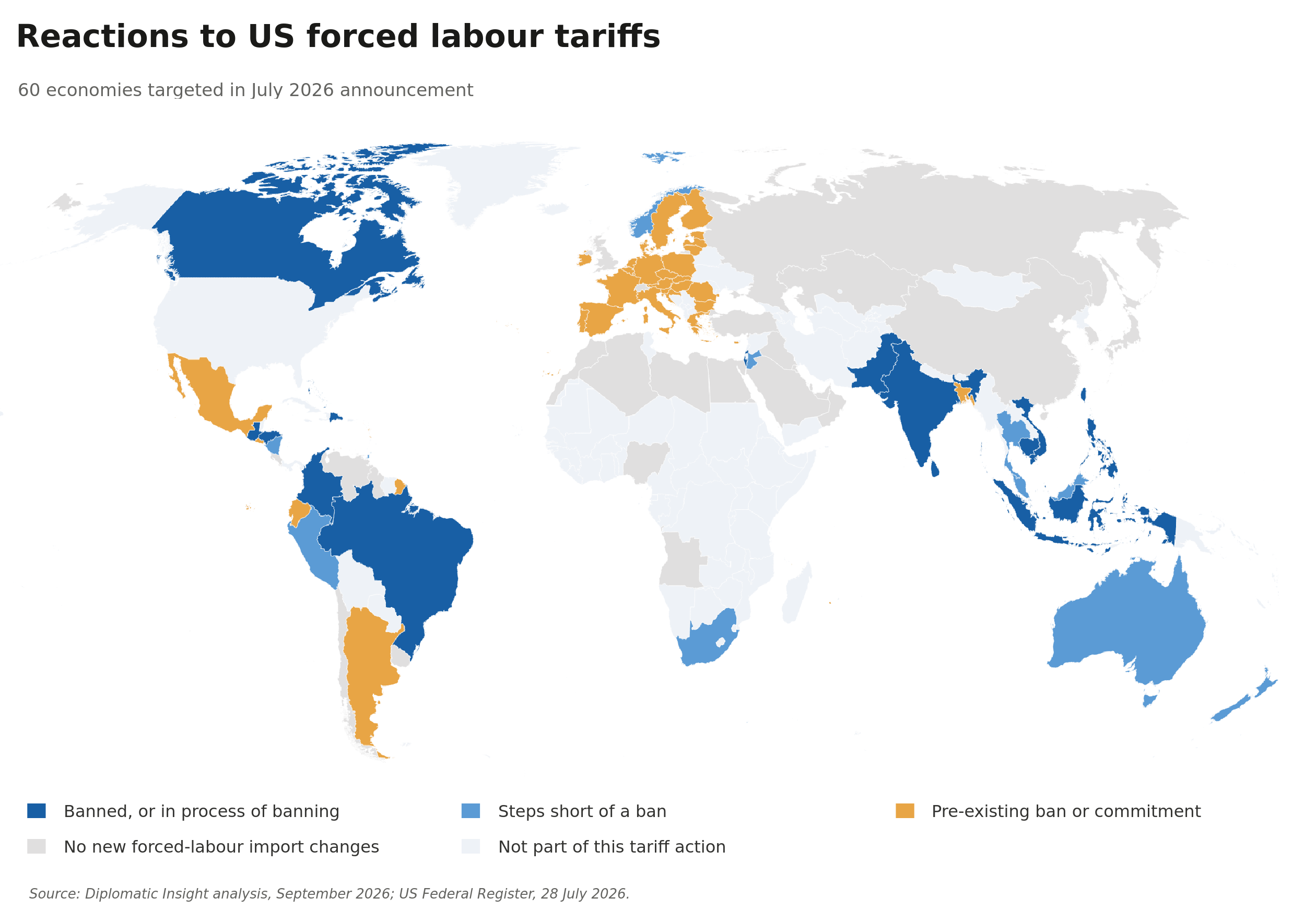
Aside from Honduras, putting the bans into practice will be harder. Most have simply created the legal powers to ban goods following, currently, theoretical investigations. Businesses and civil society are complaining of the lack of detail and uncertainty. Several governments have indicated that they expect a partner, chiefly the US, to supply the evidence of forced labour. The US domestic measures to block forced labour imports are chiefly focused on supply chains linked to Xinjiang in China. China is also likely to be a priority for the EU when it implements its Forced Labour Regulation product bans from December 2027.
Many of the economies in this wave depend on China for their industrial inputs, from agriculture and textiles to electronics and solar wafers and cells. A functioning ban, should the US choose to push for it, would mean these economies blocking goods from what is their largest supplier. The economic and political cost of that will be too much for most to handle. So most will avoid implementing their new bans. For now, that suits the US, given its objective was to impose and maintain trade tariffs.
The longer term prospects are more complicated. Now that these bans exist they are unlikely to be reversed. The trend in the West, across the political spectrum, has been to challenge the economic and geopolitical competition posed by China. Various EU and US supply chain measures have targeted China. And China has imposed restrictions on critical exports in response. The economies banning forced labour imports now for short-term tariff gain, may find themselves caught between Beijing and Washington in the longer-term.