Weekly Brief: 9 September 2026
Our view this week
This week we look at renewed American negotiation efforts in Moscow and Kyiv, positive but unlikely to find a breakthrough soon. The AfD won state elections in eastern Germany, highlighting the increasing electoral success of far right parties in Europe. With fresh US and Iranian strikes, Hormuz looks likely to remain closed and OPEC+ have frozen oil supply levels. More detailed analysis from us this week looks at the geopolitical pressures increasing prices globally.
The other headline this week is the announcement from the UK of new sanctions and trade measures on Israel. Coordinated with France, Canada and others, the announcements have drawn a strong reaction from Israel. However, the measures themselves are fairly limited and are unlikely to improve Israeli behaviour. But they look to have achieved their symbolic and political goal of securing the new UK government's leftwing support ahead of Andy Burnham's first Labour Party conference as Prime Minister. More detailed analysis on this is available.
|
|||||
|
Brent crude, European gas (TTF), gold, USD/EUR, urea. Source: OilPriceAPI, 8 September 2026. |
Key issues
Sanctions & Export Controls·Middle East & North Africa
UK and others restrict trade with Israeli settlements
Britain declared on 8 September that Israeli settler violence amounted to ethnic cleansing and accepted that occupation of Palestinian territory is unlawful. It announced a range of trade and sanctions measures on Israel, with France, Canada and others joining in banning imports from Israeli settlements. European states' actions followed EU foreign ministers failing again on 3 September to agree a bloc position, with Germany, Austria, Czechia and Hungary opposed. In response to the UK announcement, Israeli Foreign Minister Gideon Sa'ar ordered the closure of the British consulate in Jerusalem and limited UK engagement with the Palestinian Authority and Gaza support efforts. Our view, having analysed them in detail, is that the UK's measures will have limited impact, especially in the short-term. But they have achieved their domestic political goals.
Conflict & Instability·Europe & Eurasia
US envoys restart negotiations in Moscow and Kyiv
Steve Witkoff and Jared Kushner met President Putin in Moscow on 5 September, then travelled on to Kyiv for their first visit to the Ukrainian capital. This followed the CIA Director's visit to Moscow on 25 August. Three earlier rounds of talks in the UAE and Switzerland ended without agreement in February, and a round planned for March was dropped when the US and Israel attacked Iran. This week, Putin ordered a 72-hour halt to strikes on Kyiv and Zelensky offered the same for Moscow. Russia resumed missile attacks hours after it closed on 8 September. Kremlin aide Yuri Ushakov called the talks substantive, and said Putin had repeated that the war's root causes must be removed, Moscow's formula for Ukrainian neutrality and for keeping the territory it holds. Zelensky said the Kyiv discussions covered winter support, security guarantees and Patriot air defence. Our view is that this is an important step to restart negotiations, and shows the Trump Administration are still engaged. But hopes shouldn't be raised over a peace deal yet. The escalation over the summer, the increasing economic cost, and the US being keen to keep its air defence stocks, are driving this move ahead of the winter. The shape of a possible settlement has not moved since the 28-point plan of November 2025, which Zelensky has previously said was 90% agreed. Neither side is likely to move easily on the last 10%.
Politics & Governance·Europe & Eurasia
AfD wins Saxony-Anhalt but falls short of a majority
The Alternative for Germany came first in the eastern state of Saxony-Anhalt on 6 September. It won 39 of the 83 seats in the State Parliament, three short of an absolute majority. The incumbent Christian Democrats fell to 17.2%, and the Free Democrats lost their seats altogether. Every other party has ruled out governing with the AfD, so keeping it out means assembling the remaining 44 seats across four or more parties that agree on very little. Our view is that AfD will be kept out of government but this represents a growing far right pressure in the major European powers. The RN in France, Reform in the UK and AfD in Germany are all experiencing electoral successes. As we have reported elsewhere, energy and consumer prices are set to remain high, putting pressure on the cost of living. Combined with migration issues and a general frustration with government, the far right pressure looks set to continue.
Our work this week
The geopolitics driving prices higher this autumn
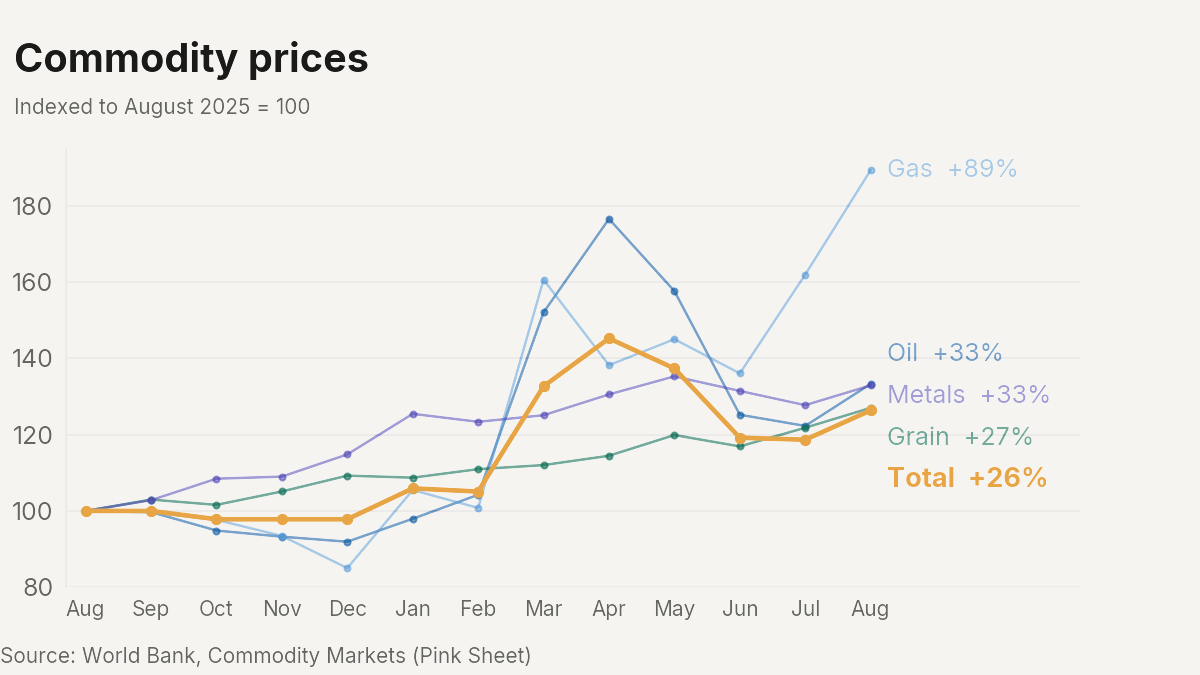
Global commodity prices are up 26% in a year. Hormuz closure, Russia-Ukraine, a hardening turn to protectionism and the strongest El Niño in decades will push them higher still. Inflation forecasts have already increased, we expect them to be revised up again in October, and interest rates across the West to rise.
Also this week
US destroys five Iranian oil tankers. US Central Command destroyed five Iranian crude tankers on 8 September, one of them near the Kharg Island export terminal, after Revolutionary Guard missile attacks on American warships in the Gulf. The Treasury issued fresh Iran-related designations the same day. Conflict & Instability · Middle East & North Africa
OPEC+ pauses its output increases for October. The seven core producers agreed on 6 September to hold October quotas at September levels, ending four straight monthly rises worth about 750,000 barrels a day in total. With Gulf exports already constrained, the pause removes a modest offset and shows the group is content with prices where they are. Resource Security · Global
Canada tariffs on US goods take effect. Canada's counter-tariffs on C$27.6bn of American imports came into force on 8 September, at rates of 15%, 25% and 50% across more than 600 product lines. Ottawa has matched the US measure of 22 August line by line. Trade & Supply Chains · Americas
Anak Krakatau volcano eruption closes eight Indonesian airports. Ash from a 25-hour eruption that began late on 4 September shut eight airports, including Jakarta's Soekarno-Hatta, the second busiest in Southeast Asia. More than 1,500 flights were cancelled or delayed and over 270,000 passengers stranded. Air freight into Java will most likely take a week or more to clear. Trade & Supply Chains · Asia-Pacific
Volkswagen to cut a further 50,000 jobs. The supervisory board approved the largest restructuring in the company's history on 3 September, taking planned reductions to about 100,000 posts and halving the model range by 2035. US tariffs and lost Chinese sales are the stated causes. Trade & Supply Chains · Europe & Eurasia
Hungary expels ten Russian diplomats. Budapest removed ten Russian officials on 8 September for activities incompatible with their status, its first such expulsion since 2018. Under Peter Magyar's government, elected in the spring, Hungary has stopped being the reliable veto Moscow relied on inside the EU and NATO. Politics & Governance · Europe & Eurasia
Ebola deaths in the DRC pass 3,000. The World Health Organization recorded 6,686 confirmed cases and 3,226 deaths in Ituri and North Kivu as of 6 September. The strain is Bundibugyo, against which the licensed vaccine and treatments do not yet work. Conflict & Instability · Sub-Saharan Africa
India ties its US trade deal to beating rivals' tariff rates. Commerce Minister Piyush Goyal said on 3 September that India will sign the bilateral agreement only once Washington offers better terms than Vietnam, Bangladesh and other Asian exporters. Trade & Supply Chains · South Asia
Coming up
| 12-13 Sep | BRICS leaders' summit, New Delhi |
| 15 Sep | EU deadline to renew its Russia sanctions listings |
| 18-20 Sep | Russian State Duma elections |
Diplomatic Insight is a British geopolitical analysis and consultancy practice with real diplomatic experience. For further analysis on any of the issues covered here or for any bespoke reporting, contact info@diplomaticinsight.co.uk.
Subscribe to get the next issue by email.