16 September 2026
Our view this week
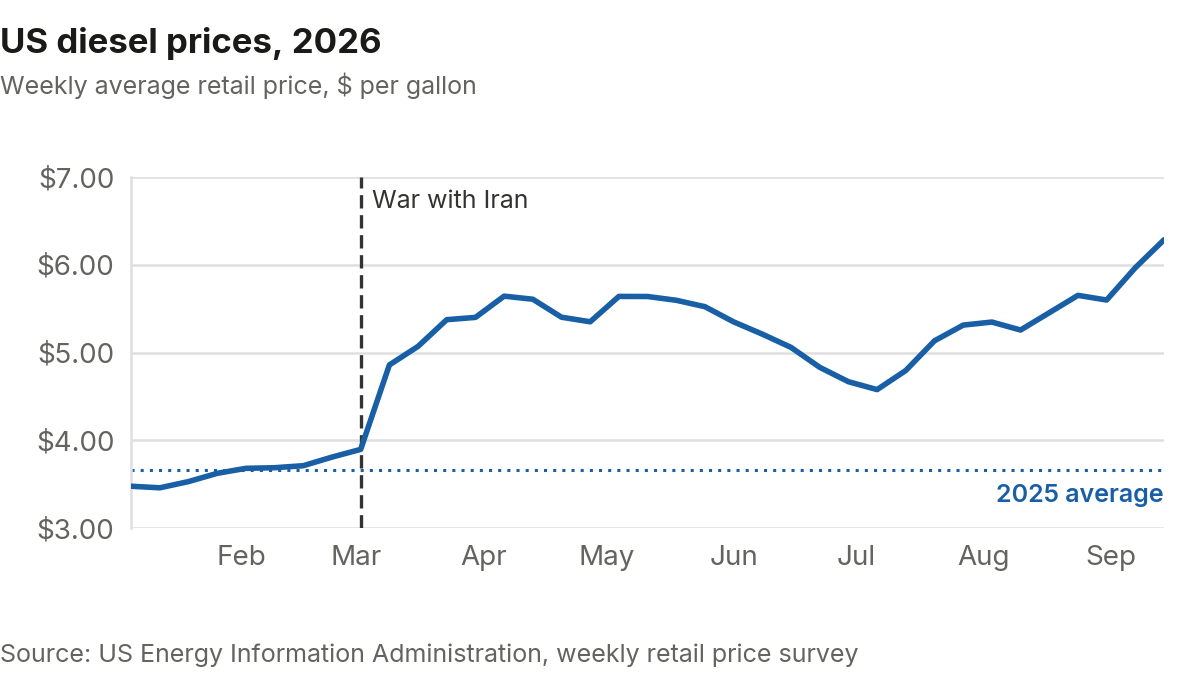
Iran and its proxies have launched an effective response this week to US sanctions and tanker strikes. The Houthis have taken control of the Bab al-Mandeb strait and the Saudi oil pipeline to the Red Sea was struck from Iraq. The result has been a 10% increase in oil prices, as domestic pressure in the West grows on the cost of Trump's war. US diesel prices have reached record levels and central banks are raising interest rates. Read our previous analysis →
Beyond the Western price shocks, the Houthis' success is a real embarrassment for Saudi (and Yemeni) military and diplomatic power. With one of the largest and theoretically capable militaries in the region, Saudi Arabia should easily be able to anticipate and prevent these threats. But it has proved otherwise. Its Mecca Pact allies Turkey and Pakistan have refused to help, despite signing the defence agreement only a month ago. The US has also been unwilling to intervene so far. Iran will be very pleased with itself this week.
|
|||||
|
Brent crude, European gas (TTF), gold, USD/EUR, urea. Source: OilPriceAPI, 15 September 2026. |
Key issues
Resource Security·Middle East & North Africa
Saudi pipeline shut and Houthis take the Bab al-Mandeb strait
Saudi Arabia shut its East-West oil pipeline on 11 September after drones launched from Iraq struck it near Riyadh and Medina. The line runs from the eastern oilfields to Yanbu on the Red Sea. It had been moving four to five million barrels a day, and is the kingdom's main way round the Strait of Hormuz. In the same 48 hours, Houthi forces took the port of Mocha, then Mayun island in the middle of the Bab al-Mandeb strait. Our view is that the Houthis probably don't have the resources to hold or administer the strait for an extended period, but the combined effect of the strikes and their presence effectively blocks any Saudi oil reaching its Asian markets. The Houthis say other shipping is safe, which will ease wider concerns if not insurance rates. Given the repeated and creative pressure from Iran and its proxies, and no sign of diplomacy, there is a strong chance oil prices could hold above $100 for several months.
Defence & Security·Europe & Eurasia
Russian drones hit a train at the Polish border and cross into Lithuania
A Russian drone struck a train on the Kyiv to Warsaw service at Yahodyn station on 13 September, two kilometres from the Polish border. All 206 passengers were evacuated and nobody was hurt. Two days later Italian jets on NATO's Baltic air policing mission shot down a drone over central Lithuania. It had crossed from Belarus and was probably carrying explosives, the Lithuanian Air Force said. That was a first in Lithuanian airspace. NATO Secretary General Mark Rutte called Russia increasingly reckless. Our view is that Russia is continuing to test NATO's tolerance and capabilities. The flurry of US diplomacy last week is long forgotten, and we expect the Ukraine conflict and Russian hybrid efforts in Europe to continue through the autumn.
Politics & Governance·Europe & Eurasia
ECB raises rates, with inflation pressure in the West
The European Central Bank raised its three main interest rates by a quarter point on 10 September, taking the deposit rate to 2.50%. It was clear that the Middle East conflict is the cause. Euro area inflation reached 3.3% in August and energy prices are up 14.3% over the year. British inflation rose to 3.1% in the year to August, which has also been put down to crude oil, petrol and airfares. US inflation held at 3.4%. Our view is that the oil and energy shock caused by the Iran war is now starting to hit home (see chart below). The US and UK also make their interest rate decisions this week. The US Federal Reserve is expected to raise rates for the first time since 2023. The Bank of England will most likely hold at 3.75%, given pressure on government debt. But we expect it to raise before the year ends.
Also this week
US pump prices hit a record. American diesel passed six dollars a gallon on 10 September for the first time, and petrol is more than a quarter dearer than a year ago. Donald Trump asked Kyiv on 13 September to stop striking Russian refineries, which he blamed for the shortage, while trying to downplay the impacts of his war. Resource Security · Americas
Pentagon admits a munitions shortfall from the Iran war. The Pentagon's Inspector General gave Congress the first official account of the Iran campaign on 14 September. Nearly four fifths of THAAD interceptors and about half of Patriot stocks are gone, with four F-15s and up to thirty Reaper drones lost. Operation Epic Fury to 30 June cost $33.4bn, with munitions taking up most of that. Defence & Security · Global
US Treasury switches to a presumption of denial on Iran licences. The US Treasury moved on 10 September to refuse Iran-related specific licences by default. These are the case-by-case permissions for otherwise banned dealings with Iran, covering humanitarian supplies, civil aviation safety and payments through American banks. Exceptions now need a legal requirement or a risk to life. Sanctions & Export Controls · Middle East & North Africa
BRICS adopts the New Delhi Declaration. The eleven BRICS members agreed a 140-point declaration on 12 September. It covers UN and IMF reform, trade in national currencies and the Gaza ceasefire. Politics & Governance · Global
Sweden's centre-left edges ahead. Preliminary results from the election on 13 September give the centre-left bloc 176 of the Riksdag's 349 seats against 173 for the right. That reverses the 2022 result. Final figures are due around 19 September. Politics & Governance · Europe & Eurasia
Canada seeks a "unique alliance" with the EU. With the US trade dispute escalating, Mark Carney said on 15 September that Canada will open talks on a close partnership with the European Union. He flew to Europe to address its parliament. Trade & Supply Chains · Americas
Rwanda and DRC meet in Geneva. Delegations opened talks in Geneva on 16 September on implementing the Washington agreement. Army and M23 fighting continues in North and South Kivu. A first report on the Doha framework, on 13 September, found that little had been delivered. Conflict & Instability · Sub-Saharan Africa
Okinawa elects a governor who accepts the US base plan. Genta Koja won the governorship on 13 September with 59% of the vote. That ends twelve years of administrations opposed to moving the Futenma US air base within the island. Politics & Governance · Asia-Pacific
Coming up
| 22-29 Sep | UN General Assembly high-level week, New York |
| 23 Sep | Morocco's parliamentary elections |
| 24 Sep | Xi Jinping's state visit to Washington |
Diplomatic Insight is a British geopolitical analysis and consultancy practice with real diplomatic experience. For further analysis on any of the issues covered here or for any bespoke reporting, contact info@diplomaticinsight.co.uk.
Subscribe to get the next issue by email.