23 September 2026
Our view this week
World leaders are in New York this week, for their annual gathering and speeches at the UN General Assembly. Trump dominates the headlines as usual, but may have mellowed. Last year, he told the whole assembly that "your countries are going to hell" for supporting open borders. This year he only threatened Iran with eternal damnation, and gave himself enough rhetorical wiggle room to end his conflict soon(ish).
Pressure is also building for further Russia-Ukraine negotiations, although progress feels unlikely. Ukraine has continued its impressive attacks on energy infrastructure. The US and EU have strengthened their sanctions measures. And NATO is feeling stronger than it has in a while, with a show of force in Eastern Europe and the US, Denmark and Greenland signing a deal on Arctic security.
|
|||||
|
Brent crude, European gas (TTF), gold, USD/EUR, urea. Source: OilPriceAPI, 22 September 2026. |
Key issues
Resource Security·Middle East & North Africa
Iran offers to reopen the Strait of Hormuz if the US lifts its blockade
In his General Assembly address on 22 September, Donald Trump said he faced a choice between a deal that lets Iran rebuild and annihilating the Islamic Republic. He added that a deal would not come until after the midterm elections on 3 November. The same day a senior Iranian official said Iran could reopen the Strait of Hormuz within seven days, if the US lifts its naval blockade of Iranian ports and states publicly that it wants a settlement. Tehran had passed a proposal on 16 September, and the two delegations then met through mediators for three hours in New York. Trump called that meeting very good. Brent crude fell about 10% over the week to just under $100. Our view is that a deal is edging closer, with Trump under pressure on fuel prices and diplomatically. We don't rule out it happening quickly, but think it is unlikely before the Israeli and US elections.
Defence & Security·Europe & Eurasia
US, Denmark and Greenland agree a deal
The three governments signed an Arctic security agreement in New York on 22 September. It amends their 1951 defence agreement to allow the US to expand Pituffik Space Base, open new defence areas, and fly and land its aircraft anywhere in Greenland. It also bars investors from outside NATO, its partners and the EU from controlling critical infrastructure or resource extraction. Our view is that this is a Danish diplomatic triumph. After over a year of unprecedented US rhetoric and threats, the deal signed is mostly a restatement of access and understandings the Americans have had since 1951. The foreign investment restrictions are new, but not particularly groundbreaking given moves across the West to protect critical national and economic infrastructure from Chinese investment. The agreement and change in tone may mean further developments in coming months with more US defence and economic investment in Greenland.
Politics & Governance·Europe & Eurasia
Electoral pressure building on German Chancellor Merz
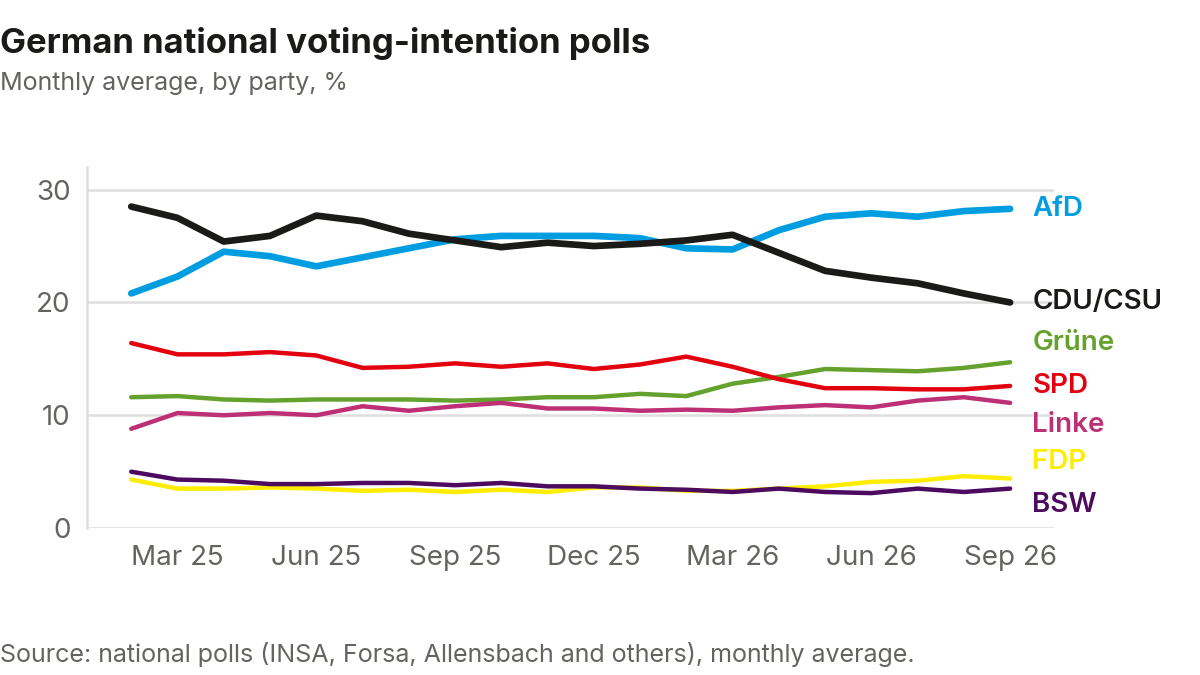
Three state elections in a fortnight have gone badly for Friedrich Merz's CDU. On 20 September the Alternative for Germany came first in Mecklenburg-Vorpommern, while, for the first time in the Federal Republic's history, the CDU failed to win any seats in a state parliament. The same day in Berlin, Die Linke came first for the first time, with CDU support falling ten percentage points. These followed the AfD's 43.8% win in Saxony-Anhalt two weeks ago. Our view is that Merz is facing a political crisis, and losing ground across the spectrum. He cancelled plans to attend UNGA to manage the fallout and prepare his controversial pension and tax package in an effort to change his party's fortunes. Federal elections aren't due till 2029, but pressure on the CDU/CSU is growing and Merz may find himself joining Keir Starmer in the discarded European leaders' club before too long.
Our work this week
Washington has accidentally driven a wave of forced labour import bans
New US forced labour tariffs, announced to replace Trump's 'Liberation Day' measures, have created a wave of new forced labour import bans.
Also this week
Trump signs the Russia and Iran sanctions law. The Lindsey O. Graham Sanctioning Russia and Iran Act became law on 18 September, with most measures due by 18 October. They include duties of up to 500% on Russian goods and tariffs of up to 100% on the five biggest buyers of Russian crude and gas. Sanctions & Export Controls · Global
EU rolls its Russia sanctions over for three years. EU ambassadors agreed on 22 September to renew listings on Russian individuals and entities for three years, in place of the usual six months. The extended time period was the compromise for delisting the billionaires Alisher Usmanov and Mikhail Fridman, which France had demanded. Sanctions & Export Controls · Europe & Eurasia
Russia takes control of Nestlé and Auchan's local businesses. Vladimir Putin signed a decree on 17 September placing the Russian operations of Nestlé, Auchan, Leroy Merlin's former chain and two logistics firms under a state-appointed manager. The Kremlin linked the seizures to European military support for Ukraine. Trade & Supply Chains · Europe & Eurasia
Ukraine says 45% of Russian refining is offline. Ukraine's General Staff said on 21 September that long-range strikes have taken more than 45% of Russia's refining capacity out of service. Recent hits were at Syzran, Yaroslavl and Moscow. It reported a sharp fall in higher-grade petrol and diesel output. Resource Security · Europe & Eurasia
Rare earths hold up the US and China trade truce. Washington and Beijing had not agreed to extend their trade truce as Xi Jinping arrived for a state visit on 23 September. The US Trade Representative blamed Chinese limits on rare earth exports. The tariff suspension expires on 10 November, if no deal is reached. Trade & Supply Chains · Asia-Pacific
Britain agrees to refuel Saudi jets against the Houthis. Prime Minister Andy Burnham agreed to a Saudi request for RAF air-to-air refuelling for aircraft intercepting Houthi missiles and drones. The support is defensive and time-limited. Defence & Security · Middle East & North Africa
United Russia wins the Duma elections. Putin's United Russia party took about 58% in elections held from 18 to 20 September. Voting was organised for the first time in the Ukrainian territories Russia occupies. Politics & Governance · Europe & Eurasia
Seven Ethiopian armed groups form an alliance. The Tigray People's Liberation Front, Amhara Fano factions, the Oromo Liberation Army and four smaller groups announced a joint alliance on 21 September to remove Abiy Ahmed's government. Several of them fought each other in the 2020 to 2022 civil war. Conflict & Instability · Sub-Saharan Africa
Coming up
| 23-25 Sep | Xi Jinping's visit to the US |
| 4 Oct | OPEC production review |
| 18 Oct | Deadline for the US sanctions law's mandatory measures |
Diplomatic Insight is a British geopolitical analysis and consultancy practice with real diplomatic experience. For further analysis on any of the issues covered here or for any bespoke reporting, contact info@diplomaticinsight.co.uk.
Subscribe to get the next issue by email.